

Permits are the part of a home addition that no one looks forward to — and the part most likely to create a frustrating surprise if you didn’t plan for it.
Here’s what Northern New Jersey homeowners actually need to know: every home addition requires permits, the permit process is managed by your local municipality (not the state), and approval timelines vary enough between towns that they can meaningfully shift your project schedule. A competent GC handles the permit process on your behalf — but no contractor can control how fast a building department moves.
This guide covers what permits are required, how the process works in Essex, Bergen, and Morris counties, and what you can do before you break ground to keep the timeline as tight as possible. For what happens after the permit is issued, phase by phase, see what to expect during a home addition.
Every Home Addition Requires a Permit — No Exceptions
If you’re adding square footage to your home, permits are not optional. (Calling it an extension? Same rule: in New Jersey an extension is an addition on the permit application.) This applies to:
- First-floor room additions and rear expansions
- Second-level additions and add-a-levels
- Master suite additions with new plumbing
- Garage conversions to conditioned living space
- Multi-room expansions that change the home’s footprint
The building permit is the foundation, but a full home addition typically triggers multiple permit types. A building permit is required for structural work, additions, or significant changes to your home. Electrical permits are needed for any electrical upgrades including new lighting, outlets, or panel changes. Plumbing permits are required for new or relocated plumbing.
For a second-level addition that includes a new HVAC zone, electrical subpanel, and primary bath — a scope we build regularly — you should expect building, electrical, plumbing, and mechanical permits to be pulled before a nail is driven.
A contractor who doesn’t mention permits in the first conversation is a red flag. They’re either planning to skip them, or they haven’t thought carefully about your project yet.
How New Jersey’s Permit System Works
New Jersey enforces the Uniform Construction Code (UCC), overseen by the Department of Community Affairs (DCA). The codes are uniform statewide and local jurisdictions are not permitted to amend them.
That’s the state layer. The local layer is where your actual permit gets issued. Permits in New Jersey are issued locally by the municipal Construction Office under the New Jersey Uniform Construction Code. The local Construction Official coordinates plan review and inspections across subcodes — building, electrical, plumbing, fire protection, and mechanical.
In practical terms: the standards are statewide, but the processing speed, communication style, and review cycle depend entirely on your specific town’s building department. A municipality with a well-staffed construction office and an online portal moves faster than one that still processes applications by mail with a two-person team.
For homeowners in Northern NJ, this matters because the towns we work in most — Morristown, Bridgewater, Verona, Cedar Grove, Westfield, Warren — each have their own office, their own timeline, and their own quirks.
What You Need to Submit
For a home addition in New Jersey, a complete permit application includes:
- Construction permit application forms — UCC forms specific to each subcode (building, electrical, plumbing, mechanical as applicable)
- Architectural plans — NJ state code requires a registered architect or licensed engineer to prepare, sign, and seal all plans, computations, and specifications required for a construction permit application. This means if you don’t already have plans, you need an architect before permits can be filed.
- Zoning sign-off — Many towns require zoning approval before UCC intake. Zoning reviews setbacks, lot coverage, impervious surface limits, and height restrictions. If your addition pushes any of those limits, you may need a variance, which adds time.
- Contractor credentials — NJ HIC (Home Improvement Contractor) registration, trade licenses, and insurance/worker’s comp documentation.
This is one reason clients who already have architect-drawn plans are further ahead than those who don’t. If you come to us with drawings and a clear scope, we can file permit applications quickly. If you’re starting from scratch, the architect phase — and then the permit phase — comes before any construction begins.
What “Permit Timeline” Actually Means in Practice
This is the honest part of the conversation.
Once your application is filed, your permit is in the building department’s queue. We can call, follow up, and respond to any revision requests as fast as possible — but we can’t make a town move faster than it moves.
The range across Northern NJ towns is real:
- Some municipalities have efficient, well-staffed departments with two-to-three week review cycles and responsive inspectors.
- Others have limited staff, older review processes, and initial review cycles that can stretch to six to eight weeks or more — before any revision cycles if plans come back with comments.
- Zoning review adds a separate approval layer, and if a variance is required, that typically involves a hearing date on the zoning board calendar, which might run monthly.
What this means for your project timeline: the construction schedule doesn’t start when you sign the contract. It starts when permits are in hand. On a second-level addition, budgeting several months from permit application to the day our crew breaks ground is realistic, not pessimistic.
Any GC who quotes you a project start date without referencing permit timelines is either guessing or telling you what you want to hear. We tell you the real timeline.
The Inspection Process After Permits Are Issued
Permits don’t end at approval. In New Jersey, additions and structural work require inspections under the NJ Uniform Construction Code.
For a home addition, inspections typically happen at multiple phases:
- Foundation / footing inspection before concrete is poured
- Framing inspection once structural framing is complete but before insulation or drywall goes in
- Rough mechanical inspections — electrical, plumbing, and HVAC rough-in, all before walls are closed
- Insulation inspection in many jurisdictions
- Final inspection — building, electrical, plumbing, and mechanical each sign off before the certificate of occupancy is issued
Each inspection needs to be scheduled in advance with the municipal construction office. This means the inspection schedule is woven into your project timeline. When a framing inspection is scheduled for Tuesday, Tuesday is when rough mechanical work begins — not before. A busy building department with a two-week inspection scheduling backlog adds two weeks to your schedule at that stage, no matter how efficiently the framing crew worked.
A well-run project anticipates these windows and schedules trades accordingly. That’s part of project management, and it’s one reason itemized proposals that spell out the project phases matter — you can see exactly where the permitting dependencies sit.
What Homeowners Can Do to Speed Things Up
You can’t control the building department. You can control the inputs.
Have your architect selected before you sign a construction contract. If you already have plans, permit applications go out quickly. If you need an architect, that phase needs to happen first, and design can take months depending on project scope. We work with architects across Northern NJ and can connect you based on your location and project fit — but the earlier that relationship starts, the better.
Make material decisions early. Materials with longer lead times — custom windows, specialty tile, out-of-state sourced flooring — need to be ordered before you need them on site. If a framing inspection passes and you’re waiting on windows, the exterior can’t be closed and the next inspections can’t happen. We flag these dependencies at the proposal stage so there’s no mid-project surprise.
Know your zoning situation before you start. If your addition is pushing setbacks or lot coverage, a variance is a real possibility. Variance hearings add time — typically at least one to two months. Finding out at permit submission is not the right time to discover this. A pre-application meeting with your municipal zoning office, or a quick review by your architect before plans are finalized, surfaces these issues early.
Budget for permit fees as a line item. In New Jersey, permit fees for new buildings and additions are often based on cubic footage for the building subcode, plus separate fees for electrical, plumbing, and mechanical. On a significant addition, total permit fees can run into several thousand dollars. This is part of the project cost, and your proposal should account for it.
Why Permits Protect You
If you’ve heard stories about contractors who skip permits to save time or money — here’s why that’s a bad trade.
Unpermitted work creates real problems at resale. Buyers in Northern NJ markets do diligence, and a title search or home inspection that surfaces unpermitted additions puts you in a difficult position: either disclose it, remediate it, or renegotiate the price. In some cases, municipalities require unpermitted work to be opened up and re-inspected — which means tearing out finished walls to prove what’s behind them.
Unpermitted work also voids homeowner’s insurance coverage for that portion of the structure. If an unpermitted addition is involved in a fire, flood, or structural failure, your claim may be denied.
We pull permits on every project. It’s not a favor — it’s part of the job.
The Bridgewater Add-a-Level: What the Permit Process Looked Like
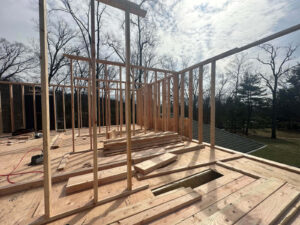
To put a real project behind the abstract process: our current Bridgewater add-a-level — a 1,000 sq ft second-story addition including a primary bedroom, walk-in closet, primary bath with steam shower, new HVAC zone, electrical subpanel, and laundry — went through building, electrical, plumbing, and mechanical permits before we started framing.
The homeowners came to us with architect-drawn plans, which accelerated the application timeline significantly. With plans in hand, we submitted a complete application immediately after the contract was signed. Somerset County municipalities generally run efficient building departments — our review cycle came back without a major revision round.
Framing alone was six days once we broke ground. The permit timeline was measured in weeks, not the framing timeline. That’s typical: the permit phase is often longer than the most intensive construction phase.
The lesson: clients who have done their homework — selected an architect, made their core material decisions, and understood the timeline — have smoother projects. Not because we work harder, but because the inputs are better.
FAQs: NJ Home Addition Permits
Do I need a permit to add a room to my house in New Jersey?
Yes. Any structural addition to a home in New Jersey requires a building permit at minimum, plus electrical, plumbing, and mechanical permits as applicable to the scope.
Who pulls the permit — me or my contractor?
Your licensed GC pulls the permits on your behalf. This is standard practice and ensures the work is tied to a licensed, insured contractor who is accountable to code. A contractor who asks you to pull your own permits as an “owner-builder” to avoid licensing requirements is a different conversation — and not one we have.
How long does a home addition permit take to get approved in NJ?
It depends on your municipality. Initial review can take anywhere from two to six weeks in efficient departments; longer in others, especially if plans require revisions or zoning approval is needed. Variance hearings add additional time. Build several months of total permit-to-start time into your planning horizon.
What happens if my addition doesn’t meet setback requirements?
You’ll need a variance from your local zoning board. Variance hearings typically run on a monthly schedule, so this adds time depending on where you are in the cycle when the application is submitted. Your contractor and architect can identify setback issues before plans are finalized.
Do I need an architect for a home addition in NJ?
For any addition requiring a construction permit, yes — New Jersey state code requires plans to be prepared, signed, and sealed by a registered architect or licensed engineer. A homeowner building on their own property can draw plans for their own personal use, but additions built by a licensed GC require sealed drawings.
What is a certificate of occupancy (CO) and do I need one?
A CO is issued by your municipality after all final inspections pass. It certifies that the addition was built to code and is approved for occupancy. You will need it. We don’t consider a project complete until the CO is in your hands.
Ready to Talk Through Your Addition?
If you’re planning a home addition in Northern New Jersey — Essex, Bergen, Morris, Somerset, or Union County — the permit process is one of the first things we talk through. We handle the application, manage the inspection schedule, and keep you informed at every stage.
The one thing we’ll be upfront about is that the building department sets its own clock. What we can control, we do. What we can’t, we plan around.
Reach out for a free estimate. We’ll walk the site, review the scope, and give you a realistic picture of what the full timeline looks like — permits included.